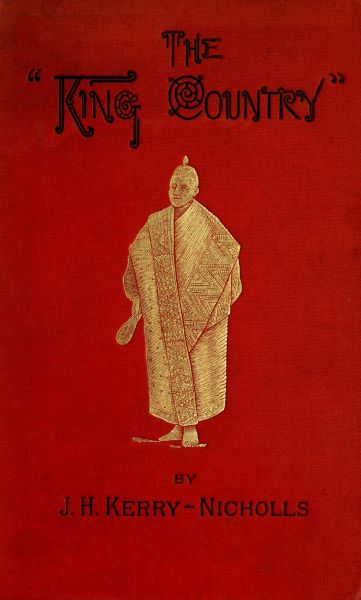

KING TAWHIAO.
THE KING COUNTRY;
OR,
EXPLORATIONS IN NEW ZEALAND.
A NARRATIVE OF 600 MILES OF TRAVEL THROUGHMAORILAND.
BY
J.H. KERRY-NICHOLLS.

THE AUTHOR.
WITH NUMEROUS ILLUSTRATIONS AND A MAP.
SECOND EDITION.

SAMPSON LOW, MARSTON, SEARLE, & RIVINGTON,
CROWN BUILDINGS, 188, FLEET STREET.
1884
[All rights reserved.]
THIS WORK IS DEDICATED
BY PERMISSION
TO
SIR GEORGE GREY, K.C.B., F.R.S.,
WHOSE CAREER
AS GOVERNOR, STATESMAN, ORATOR, AUTHOR, AND EXPLORER,
HAS SHED LUSTRE
UPON
THE HISTORY OF AUSTRALASIA.
PREFACE.
In publishing this record of travel, I have deemed it advisableto arrange my narrative under four principal divisions. In theintroductory portion I refer to the leading physical features of thatpart of the North Island of New Zealand known as the King Country,relate the leading incidents connected with its history, describe thecondition of the native race, and explain the object with which myjourney was undertaken. The succeeding chapters deal with my visit tothe Maori King when presenting my credentials from Sir George Greyat the tribal gathering held at Whatiwhatihoe in October, 1882. Thedescription of the Lake Country includes my route from Tauranga, onthe East Coast, to Wairakei, and which led me through the marvellouslyinteresting region familiarly termed the Wonderland of New Zealand,while in the pages embracing my explorations in the King CountryI record events as they occurred from day to day over a lengthyjourney which was delightful on account of its novelty and variety,and exciting by reason of the difficulties, both as regards naturalobstacles inseparable from the exploration of an unknown region under[Pg viii]the unfavourable conditions by which I was constrained to carry it out,and the deep-rooted jealousy of the native race against the intrusionof Europeans into a portion of the island which is considered by themto be exclusively Maori territory.
When it is considered that in company only with my interpreter, andwith but three horses—ultimately reduced to two—and with what scantprovisions we could carry, I accomplished considerably over 600 milesof travel, discovered many new rivers and streams, penetrated almostinaccessible regions of mountainous forest, found extensive areas ofopen plains suitable for European settlement, traced the sources ofthree of the principal rivers of the colony, examined the unknownshores of its largest lake, ascended one of the highest mountains ofthe southern hemisphere, experienced degrees of temperature varyingfrom 80° in the shade to 12° below freezi