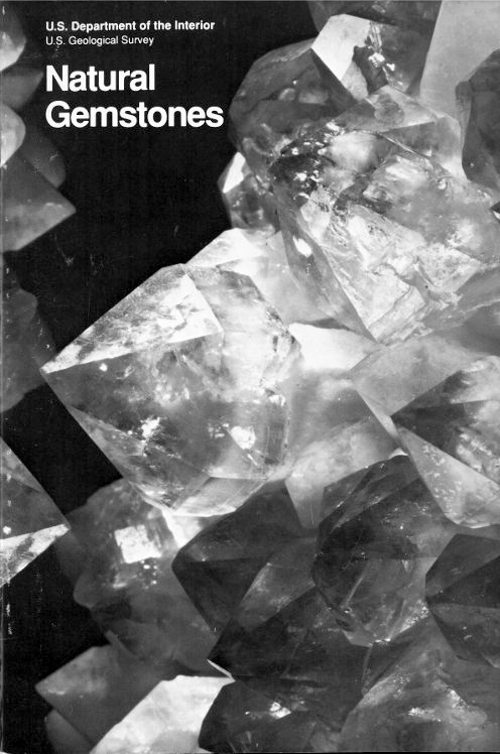

Quartz, Rhode Island.

Amethyst crystals, Mexico.
U.S. Department of the Interior
U.S. Geological Survey
Natural
Gemstones
Searching for gemstones in the United Statesis a popular recreational activityfor collectors and hobbyists
Natural gemstones
A natural gemstone is a mineral, stone, ororganic matter that can be cut and polishedor otherwise treated for use as jewelry orother ornament. A precious gemstone hasbeauty, durability, and rarity, whereas asemiprecious gemstone has only one or twoof these qualities. A gem is a gemstone thathas been cut and polished.
Diamond, corundum (ruby and sapphire),beryl (emerald and aquamarine), topaz, andopal are generally classed as preciousstones. All other gemstones are usuallyclassed as semiprecious.
A mineral is any naturally formed homogeneousinorganic material.
A mineralogist is a person who studies theformation, occurrence, properties, composition,and classification of minerals.
A gemologist is a person who has successfullycompleted recognized courses ingemology (the science and study of gemstones)and has proven skills in identifyingand evaluating gem materials.
A lapidary is a cutter, polisher, or engraverof precious stones.
Geologic environment
Gemstones are not plentiful. Gemstones donot form “ore” deposits in the normal sense.
Gems, when present at all, tend to be scatteredsparsely throughout a large body ofrock or to have crystallized as small aggregatesor fill veins and small cavities.
Even stream gravel concentrations tend tobe small—a few stones in each of severalbedrock cracks, potholes, or gravel lensesin a stream bed.
The average grade of the richest diamondkimberlite pipes in Africa is about 1 partdiamond in 40 million parts “ore.”Kimberlite, a plutonic igneous rock, ascendsfrom a depth of at least 100 kilometers(60 miles) to form a diatreme (narrowcone-shaped rock body or “pipe”). Moreover,because much diamond is not of gemquality, the average stone in an engagementring is the product of the removal and processingof 200 to 400 million times itsvolume of rock.
Gemstones occur in most major geologic environments.
Each environment tends to have a characteristicsuite of gem materials, but manykinds of gems occur in more than one environment.Most gemstones are found inigneous rocks and alluvial gravels, butsedimentary and metamorphic rocks mayalso contain gem materials.
Examples of geologic environments inwhich gemstones are found:
Pegmatite—a coarse-grained intrusiveigneous rock body, occurring as dikes (atabular-shaped body), lenses, or veins in thesurrounding rock.
Stream gravels (placers)—deposits ofheavier and more durable than averageminerals that have been eroded out of theoriginal rock. Often tourmaline, beryl, andmany other gem-quality minerals haveeroded out of the original rock in whichthey formed and have moved and beenconcentrated loc